

A K–8 story series
that teaches financial behavior.
Five illustrated books for ages 5–14, built to be read aloud. There is nothing to install and no lesson to plan — the financial thinking is carried by the story, and children meet it before anyone names it.
Start where you are
I teach, or I run a library
Start with one book and a read-aloud. Nothing to install, no student accounts, no training required first.
What a class period looks like →I lead a school or district
Standards crosswalk, pacing guides and the evidence base are published documents — read them before you talk to us.
Standards & documents →I'm a parent or caregiver
The books are sold directly, and the practice simulation is free. No school required to start.
For families →I fund or review
What is measured, what is not yet validated, and what a funded cohort produces — stated plainly.
Evidence & measurement →The Series
This is what your students will see.
The characters, the world, the energy — built from the ground up to hold a child's attention while the behavioral concepts do their work underneath.
Explore the Books →K–8
Grade Range
Ages 5–14
6
Behavioral Archetypes
Embedded in narrative
5
Books in Series
Part of a planned 10-book arc
$0
To Begin
The $100 Week™ — free, no paperwork
Founding Pilot Cohort · 2026–27
Already with students. Now opening to founding schools.
The Adventures series now opens to a small founding cohort of schools, with founding pricing and priority onboarding before the full launch.
Apply for the Pilot →From a Chicago youth program · summer 2026
“Our students had the opportunity to make real-life financial decisions while thinking critically about how those choices aligned with their personal values and morals. It was great to watch them weigh their options, navigate the consequences, and make thoughtful decisions—it made financial literacy feel meaningful and relevant to their everyday lives, especially since the simulation was tailored to a Chicago youth.”
K. Harper — Program Advocate, Youth & Family Services
The Architecture
Two layers. One story.
Children absorb behavior before they can name it, and that is the design. Every book in the Adventures series operates on two simultaneous frequencies. The child never sees the second layer. The adult can't unsee it.
1
Child Layer
Adventure & Comedy
Children experience an adventure story — something is happening, somebody noticed it, The Magpyes figure it out. Humor, heart, and genuine stakes. The financial concepts are completely invisible.
2
Adult Layer
Behavioral Finance Patterns
Grown-ups reading alongside recognize the exact behavior patterns — loss aversion, information asymmetry, authority legitimacy, voluntary exchange, social proof. Both layers are real. Neither announces itself.
Why It Works
Behavior is installed before it's named.
Children recognize the pattern from the story when they encounter it in real life — often years later.
The story carries the behavior without requiring a lesson. Children don't feel taught. They feel like they figured something out.
The Name Nothing Rule ensures the financial concept never becomes the point of the adventure. The adventure is always the point.
Behavioral Archetypes
Six characters. Six financial behavior patterns a child can see themselves in.

The Engine
Miller
High-risk, high-reward thinking. Natural loss aversion bypass. Miller demonstrates what happens when you optimize for action over information — sometimes brilliantly, sometimes expensively.
The Authority
Naiya
Social proof dynamics. Authority legitimacy. The cost of being positioned as the expert when the domain shifts.
The Contradiction
Macon
Loss aversion in its clearest form. The endowment effect. Why parting with something feels qualitatively different from not gaining the same thing.
The Intelligence
Ava
Information credibility. Expertise discounted by proximity and age. What it costs to be right and young.
The Wildcard
Sai
Value vs. price. Voluntary exchange creates surplus on both sides. Optimizing for what actually matters, not for what is measurable.
The Skeptic
Brooke-Lynn
The economics of honest information. What it costs to be the person who tells the truth. Social value of accurate signal in a group.
The Comic Relief
Timmy
Free-riding. What it costs a group when someone wants the payoff without the work — and what it costs them to keep saying no, or to stop.
The FLIQ Score™
The data your students generate — automatically.
Students don't take a test. The FLIQ Score™ is read from the decisions they make in The $100 Week™, CoinQuest™ and book-linked activities, and reported to adults as a band and a number on a 117–936 scale. A child sees progress and moments, never a rank.
Where this stands. The FLIQ Score™ is an emerging behavioral measure. It is designed to measure and structured to observe, but it has not been validated in the psychometric sense, and no figure shown anywhere on our sites is an observed outcome. Its standing against the AERA/APA/NCME standards is published in full, and we would rather you read that before you decide than after.
How the score is read, on fliqscore.org →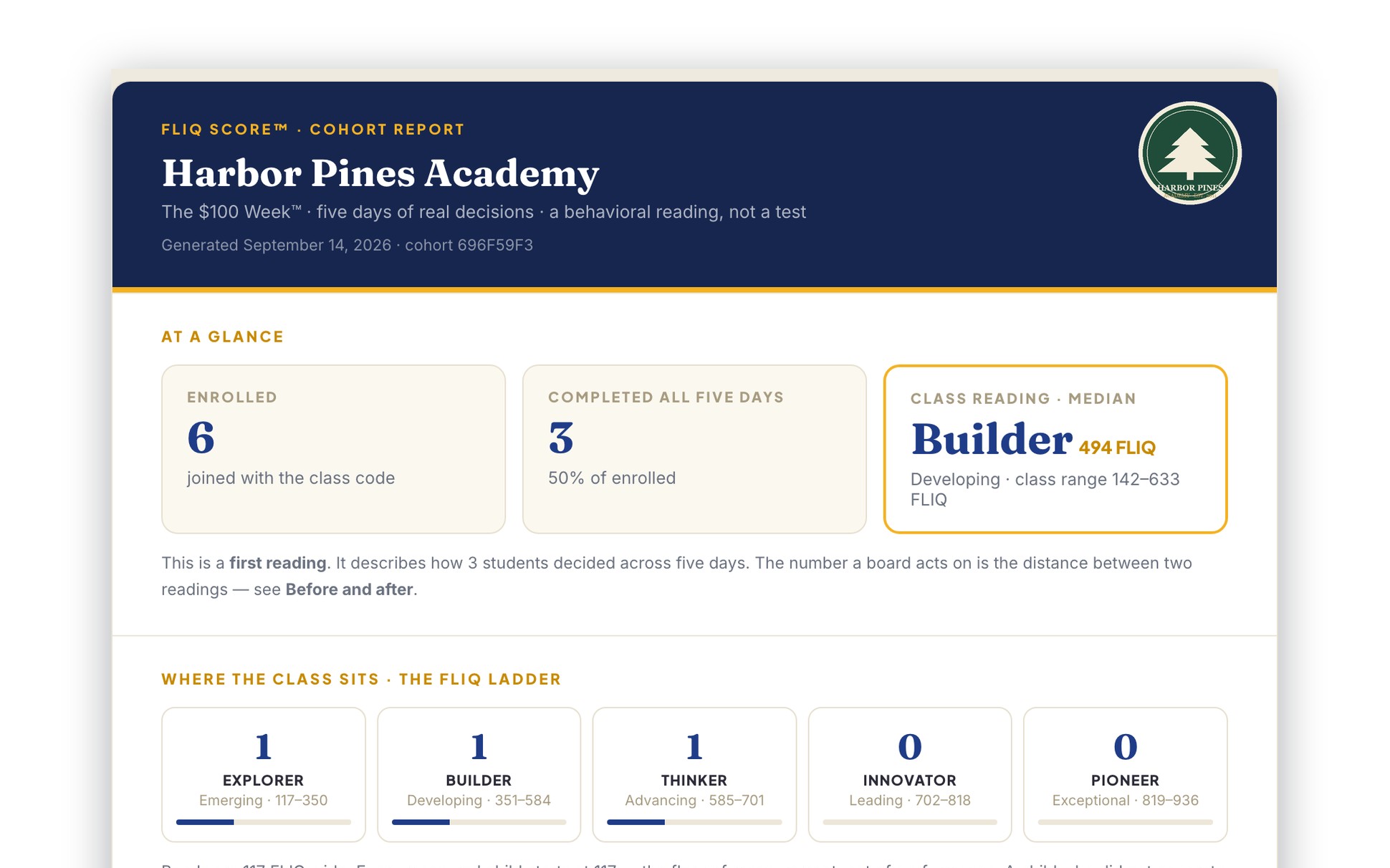
Sample report, illustrative data.
For Families
You don't need a school to start this.
The books are sold directly, and the simulation the books lead into is free to play in a browser — no account for your child, no paperwork, no sales call. Read one together, then let them run a week of their own money and see what they do with it.
Standards Alignment
Mapped to the frameworks your institution already uses.
Three frameworks, summarised below and mapped book by book in the Adventures™ Standards Crosswalk — which also names the four financial categories five picture books do not reach. Nothing here is endorsed by the framework owners; the alignment is ours.

CCSS
ELA Common Core
- RL.K–8.1 — Key ideas and details
- RL.K–8.3 — Character analysis & motivation
- RL.K–8.6 — Point of view and purpose
- RL.K–8.9 — Compare texts within a series
- SL.K–8.1 — Collaborative discussion
SEL
CASEL SEL Framework
- Self-Awareness — financial identity & behavior patterns
- Social Awareness — perspective-taking across character types
- Responsible Decision-Making — trade-offs, risk, consequence
- Relationship Skills — cooperation within The Magpyes dynamic
K–12
Jump$tart Financial Literacy
- Earning — value creation and recognition (Books 1–2)
- Spending — decision-making under constraint (Books 1, 4)
- Saving — deferred gratification as behavior (Book 4)
- Investing — future-value thinking before vocabulary
- Social Influence — peer pressure and financial choice
Adventures™ Standards Crosswalk
The five books, mapped book by book to Jump$tart, CASEL and the Common Core ELA anchors — including the four financial categories five picture books do not reach, named.
Read the document →PDF · Financial Foundations™ curriculumJump$tart Standards Crosswalk
Every unit of the Financial Foundations™ curriculum mapped to all seven Jump$tart National Standards categories, across four K–12 bands.
Read the document →PDF · Financial Foundations™ curriculumK–12 Scope & Sequence
What is taught in which grade, in order, across the whole curriculum — the document a curriculum office asks for first.
Read the document →PDF · Financial Foundations™ curriculumResearch & Evidence Base
The research the design rests on, and — stated plainly — where our own evidence is still thin.
Read the document →Everything your decision-maker needs, on one printable page.
Stats, story hooks, standards, pilot details and pricing, formatted for a budget meeting. Districts routinely fund programmes of this type as Well-Rounded Education activities under ESSA Title IV-A; we supply the documentation your federal-programmes office needs to make that determination.
The Ecosystem
The books are the entry point. The franchise is the destination.
Schools and libraries that bring in the Adventures series today are establishing a relationship with a franchise property — not purchasing a unit study.
01
Behavioral Installation
Adventures Books
Where financial behavior is first observed — embedded invisibly inside an adventure children actually want to read. No lesson plan required.
02
Applied Practice
$100 Week™ + CoinQuest™
Where behavior is practiced. A browser simulation and a student fintech app that generate real, quantifiable behavioral data through play.
03
Institutional Scale
iMPACT Partners™
Where educators become certified facilitators. The institutional layer that certifies delivery across classrooms, after-school programs, and districts.
Five-book series, available through inquiry. Founding schools join a planned 10-book franchise arc from the first chapter. Inquire →
Who are you here for?
I work with a school, district, or library.
Curriculum directors, superintendents, principals, teachers, and librarians — start your pilot inquiry here. We scope each engagement to your institution.
Start the inquiry →I run programs or want to facilitate.
After-school leads, community org staff, and iMPACT Partners — your portal is a separate door. Your certification, your cohorts, your data are all there.
Go to iMPACT Partners →

Milo Peregrine
“The Crew figures things out. That's always been the rule.
I'm just here to make sure the right people are watching.”
Start the Conversation
Your institution. Your students. One conversation to start.
We are building the founding pilot cohort now. Curriculum directors, principals, librarians, and program administrators — if you work with K–8 students, this is the inquiry to submit.
First-mover access to a planned 10-book franchise arc
You are not licensing a workbook. Founding schools are establishing their institution in a growing ecosystem while it is still in its early chapters.
FLIQ Score™ behavioral data — proprietary to this program
The Adventures series is built to generate behavioral assessment data — quantified through the FLIQ Score framework. Your students' financial decision-making patterns, tracked over time.
Zero lesson planning required
The curriculum lives inside the story. Implementation begins with a book and a read-aloud. The iMPACT Partners certification handles the educator layer.
Documentation for Title IV-A budget alignment
The programme maps to Well-Rounded Education activities under ESSA. Eligibility is your district's determination to make — we provide the documentation your federal-programmes office needs to make it.
What Happens Next
You hear from us within 48 hours
A real person — not a bot — reviews your inquiry and reaches out personally.
You get a written reply
A pilot plan scoped to your grade levels and program, in writing. No homework on your end.
We build the proposal together
Scoped to your institution, grade levels, and grant eligibility.
Send Your Inquiry
WealthWise Kids Adventures · Institutional Inquiry
You’ll hear from us within 48 hours. No sales calls. No automated sequences. A real conversation about your students.
Start Here
Start with the story.
The rest of the franchise follows.
Five-book series. A planned 10-book arc in progress. An ecosystem already live.